
Written by Judit Bőhm and Aydan Gurbanova, Clean Air Action Group, Hungary.
If parents realised how beneficial it is for their children to travel to school (and many other places) on foot, by bicycle, or via public transport, many would likely stop driving their children – write psychologist Judit Bőhm and environmental consultant Aydan Gurbanova, volunteers at Clean Air Action Group (CAAG), Budapest, Hungary.
We often read about the harmful consequences of heavy traffic: poor air quality, noise, accidents, the loss of green spaces and so on. Let us now look at it from the other side: if we go on foot, by bicycle or via public transport instead of by car, we not only bring about positive changes regarding the factors just mentioned, but we also do something good for our children – and, certainly, for ourselves.
Children who walk or cycle to school are better able to concentrate, according to a large-scale study conducted in Danish schools. Nearly 20,000 children aged 5 to 19 participated in the “Mass Experiment 2012” research. The results showed that those who walked or cycled to school – rather than traveling by car – performed significantly better in tasks requiring attention. The beneficial effects of this physical activity lasted throughout the morning.
A Spanish study involved 1,700 adolescents aged 13 to 18. Researchers assessed the cognitive performance of young people from various schools across five Spanish cities, and the results clearly showed that those who walked or cycled to school in the morning performed better on verbal and mathematical tests.
Active commuting fosters the development of several skills beneficial for academic performance – and life in general – such as a sense of balance, spatial and temporal orientation, and the ability to accurately gauge distance and speed. Children who travel this way may even see improvements in their self-confidence and understanding of rules, as they actively participate in making small decisions along the way.
The experience of developmental specialist Anita Detre also shows that “it makes a huge difference whether a child is driven to and from school, sitting in a car and playing on a phone, or gets there actively – cycling, or walking. Children who are driven often cannot say for sure how far they live from their school or kindergarten. When asked, the typical answer is ‘close’, because they do not perceive the actual distance or the route they travel from home.”
Walking or cycling with our children can also be beneficial because they become familiar with traffic rules along the way. Furthermore, the time spent together can strengthen the parent-child relationship (though one should approach this carefully, as the nature of parent-child relationship and how it might be improved depend on a multitude of factors). As for the children themselves, a study by micromobility expert Ákos Bereczky reveals that the majority – at least during their early primary school years – prefer getting around on foot, by bicycle, or via other active modes of transport.
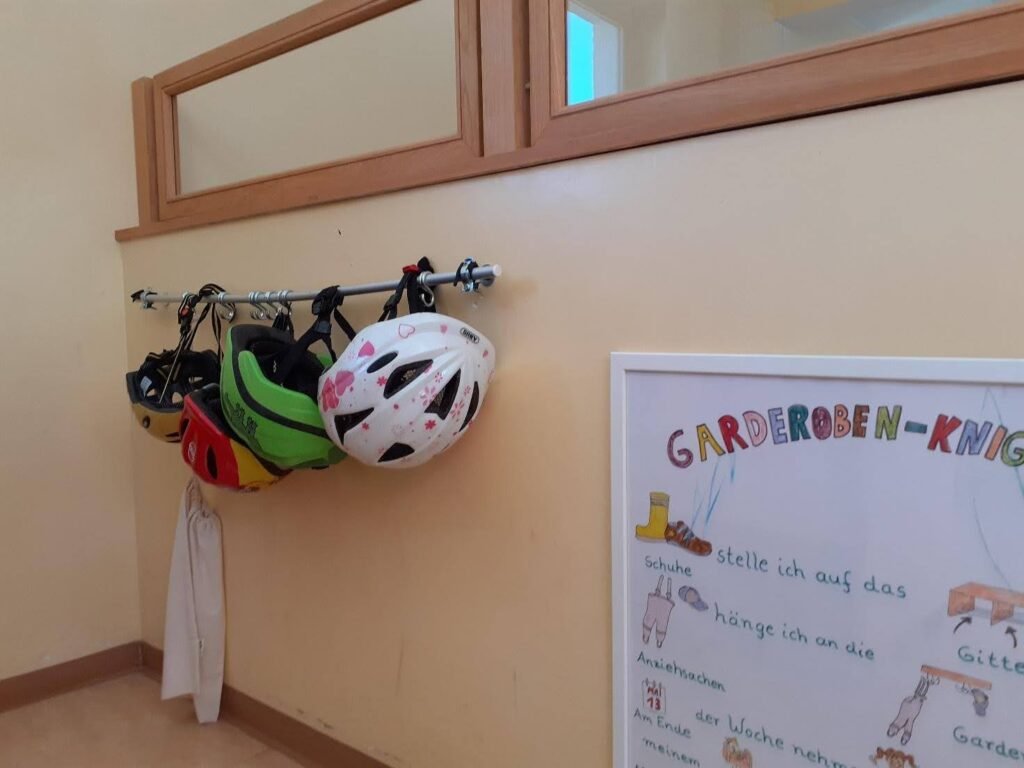
The dressing room of a Berlin kindergarten. In the German capital almost all children go to kindergarten by bike or on foot (in the case of cycling younger children ride on their parent’s bike or in a bike trailer, while older ones ride their own bikes accompanied by a parent).
(Photo by CAAG)
Exercise
The issue of a sedentary lifestyle is also relevant here and poses a significant challenge: compared to World Health Organization (WHO) recommendations, globally 81 percent of adolescents aged 11–17 do not get enough physical activity, and children spend, on average, less than half the time playing outdoors than their parents did. The proliferation of digital devices like smartphones further reduces the amount of physical activity among children (and adults). According to the WHO physical inactivity is the fourth leading risk factor for mortality and contributes significantly to the development of musculoskeletal and other disorders.
Outdoor play is essential for a child’s healthy development. The WHO recommends that children aged one to five spend at least three hours a day engaged in various physical activities, while for those aged five to seventeen, it advises at least one hour of daily physical activity – whether moderate or vigorous. Outdoor play has a positive impact on mental health as well as cognitive and executive functions; it reduces the risk of developing chronic diseases (such as obesity, cardiovascular disease, and type 2 diabetes) and enhances overall well-being. Naturally, it is also important that time spent outdoors – such as the commute to and from school – takes place in areas with minimal air pollution; yet another argument against cars.
According to a survey, 60 percent of British children aged 4 to 11 never play on the street where they live. When asked about this, parents stated that they did not consider their streets safe. Meanwhile, a survey published by the German Transport Club (VCD) found that 79 percent of children living in traffic-calmed streets do play outside regularly, compared to just 18 percent in streets with heavy traffic.
Safety or the lack of it?
Road safety is of paramount importance to children. Worldwide, 1.19 million people die in road accidents each year. Traffic accidents are the leading cause of death among children and young adults aged 5 to 29. According to data from the European Transport Safety Council (ETSC), more than 6,000 children under the age of 14 died in road accidents in the European Union between 2011 and 2020.
In Hungary, between 2019 and 2023, 52 children lost their lives in road accidents, and another 763 suffered serious injuries. Nearly half (43 percent) of them were involved in accidents while under adult supervision: they were either passengers in their parents’ cars or walking with their parents.
If the goal is for as many people as possible to travel to kindergarten or school using active modes of transport, then safe conditions must be established for this.
Noise
Like air pollution, noise pollution is a growing global problem, too. Noise is one of the environmental factors most harmful to health. Excessive noise increases chronic stress levels, impairs sleep quality, and raises blood pressure. In cities road traffic is the primary source of noise.
Noise poses a serious problem for children as well. For instance, noise reaching the classroom can disturb students and impair their ability to concentrate. A study conducted as early as 1975 found that students seated on the noisy side of the school building performed worse on reading tests than those seated on the quiet side.
„Constant exposure to noise increases the stress-related cortisol response and, over time – as we progress from childhood to adulthood – damages physical and emotional health,” says Iroise Dumontheill, Professor of Cognitive Neuroscience at Birkbeck, University of London.
What can we do?
Over the past few decades, our circumstances have changed to the point where not everyone can simply walk, cycle, or take public transport to get their child to school or kindergarten. For instance, if someone lives far away, commutes a long distance to work, lacks safe cycling infrastructure, or finds public transport connections overly complicated, they might choose to drive – even if they realize it isn’t the ideal choice.
The situation is complex, involving various life circumstances and arguments on both sides. Nevertheless, we can state that, whenever possible, the best approach is to accompany our children to school or kindergarten on foot, on micromobility devices, or via public transport. We can also team up with other parents. There are already many excellent examples of this, both internationally and in Hungary. These include „school streets” (where vehicle access to the street in front of the school is restricted either temporarily or permanently) and „walking buses” or „bicycle buses” (where children travel to school together on foot or by bike, accompanied by one or more adults). Establishing school streets can also help foster these positive changes.
By driving our children as infrequently as possible, we also socialize them to get used to the idea of using a car only when absolutely necessary.
The authors express thanks Romaine Bouillon, an intern at the Clean Air Action Group, for her assistance in collecting and processing relevant literature.