
An annual assessment by environmental researchers has found that only three cities out of 40 surveyed would meet the revised EU limits for two of the most dangerous air pollutants. These limits are expected to become law across the EU by the end of 2026.
The Clean Cities’ Free To Breathe Ranking has found a stark regional divide in air pollution, with Copenhagen, Greater Stockholm and Greater Helsinki the only major European cities currently meeting the revised EU limits for both Nitrogen Dioxide (NO₂) and Particulate Matter (PM₂.₅). This means that 93% of the cities studied would likely breach the new legal limits set by the EU.
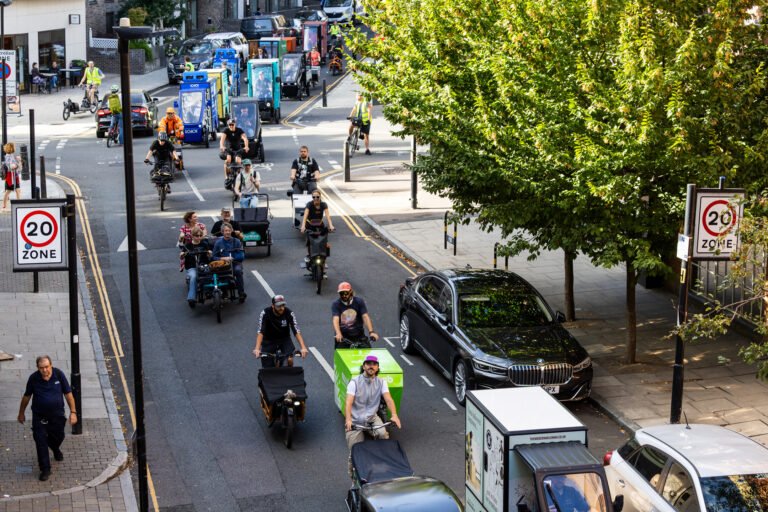
The report highlights progress across cities – including Copenhagen, London, Paris and Stuttgart – as the result of clean transport measures, including low and zero-emission zones, bus electrification, school streets and improvements to cycling infrastructure that have reduced pollution.
The study assesses cities against four indicators: current air pollution levels, compliance with the EU’s revised Ambient Air Quality Directive (AAQD) limits, progress over the past decade, and key transport measures being taken to tackle pollution. The ranking grades cities from grade A to F with grades awarded based on these four metrics.
The study’s findings show:
Ambitious transport policies to reduce NO₂, such as Stuttgart’s ‘Umweltzone’; measures to reduce car use and incentivise cycling across Greater Paris; and London’s Ultra Low Emission Zone (ULEZ) means these cities show large reductions in the past 10 years.
The results also reveal substantial differences between cities within the same country. Ghent ranks fourth, ahead of Antwerp in 21st place; Bilbao ranks sixth, ahead of Madrid in 26th; and Florence ranks 22nd, ahead of Turin in 37th. This divide highlights the importance of ambitious policy choices by individual city leaders.
Barbara Stoll, Founder and Senior Director of Clean Cities, said:
“People in Central, Eastern and Southern Europe should not have to accept dirtier air because their city leaders have failed to act. Athens has seen little improvement in air quality over the past decade, and also performs poorly in our research on the policies needed to tackle transport pollution. In contrast, Copenhagen has delivered a fully electric bus fleet, a well-functioning Low-Emission Zone, excellent cycling infrastructure and school streets.
“Air pollution is not inevitable. Our research shows that cities can make a real difference through strong leadership. Crucially, improving air quality doesn’t always require major financial investment. Our study highlights that cities can make meaningful progress through affordable measures such as expanding cycling networks and introducing school streets.”
The findings come as EU Member States prepare to transpose the revised Ambient Air Quality Directive into national law by 11 December 2026, alongside the development of national air quality roadmaps and, where applicable, requests for extensions up to 2035. Overall compliance with the new limits is expected by 2030.
Dr Maria Neira, former Director of the World Health Organization (WHO)’s Department of Environment, Climate Change and Health, and prospective candidate for the position of WHO Director-General, said:
“Clean air is one of the most powerful investments a city can make in public health. Every decision to reduce traffic pollution is an opportunity to prevent disease and create healthier streets for everyone. These findings show that progress is possible, but far too uneven. Protecting people’s health requires leadership and political determination. Meeting legal limits is an essential milestone; our ambition must be air that protects health, wherever people live.”
Through the Free to Breathe campaign, also launched today, Clean Cities is calling for governments and cities to use this process to accelerate action rather than delay it, with clear plans to bring pollution down and targeted measures to tackle major urban sources.
The Clean Cities City Ranking 2026 covers 40 major European cities and is based primarily on air-quality data from the European Environment Agency (EEA), alongside a qualitative assessment of selected city-level policy measures.
The ranking is not a formal EU legal compliance assessment. It uses a methodology designed to compare cities consistently and includes a mixture of municipalities and wider metropolitan areas, reflecting the territorial units available in the underlying EEA data.
The three cities at the top of the ranking are: 1. Copenhagen | 2. Greater Stockholm | 3. Greater Helsinki
The lowest-ranked cities are: 38. Zagreb | 39. Bucharest | 40. Athens
The ranking also finds that:
The Clean Cities City Ranking uses measured rather than modelled concentrations and is therefore subject to differences in monitoring coverage between cities. It is intended to identify broad patterns and differences in progress rather than overinterpret small differences between closely ranked cities.
Source: European Environment Agency, Annual Air Quality Statistics (AirBase and e-Reporting merged), supplemented by Clean Cities policy research. About us Clean Cities is a European coalition of more than 150 NGOs and grassroots groups that builds public support for cities to shift from polluting cars to active, shared and electric mobility.
Summary table availale at: cleancitiescampaign.org/city-ranking-2026-free-to-breathe/