
A guest analysis written by Viktória Biró and András Lukács, Clean Air Action Group, Hungary.
The real speed of an average car is barely higher than that of a pedestrian. Although there can be significant differences from the average, it is a fact that the real speed of cars is much lower than what the odometer shows. Anyone can easily calculate this figure for their own car.
To determine the average speed, the distance traveled must be divided by the time spent. While the distance of the trip is relatively easy to determine, calculating the total time spent on the trip is more complicated. The time we spend in our car on a road is only a part of the time we devote to car use, as we also spend a lot of time generating the resources required for driving.
In his 1978 book “Towards a History of Needs”, the Austrian-born philosopher Ivan Illich first demonstrated the real (social) speed of an average American motorist, which was roughly equivalent to the speed of a fast pedestrian. Illich pointed out that although cars create the illusion of speed, in reality, due to their enormous time and resource requirements, they take at least as much time from an individual’s life as they save. A calculation published in 1991 in Clean Air Action Group’s journal Lélegzet (Breath) concluded that the real speed of driving in Hungary was around 5.5 km/h on average.
Dusting off the previous analysis, we made a fresh test calculation for an average car in Hungary: a four-year-old Suzuki Swift. The expenses spent on the car included in the calculation are based on our own experience and public sources.
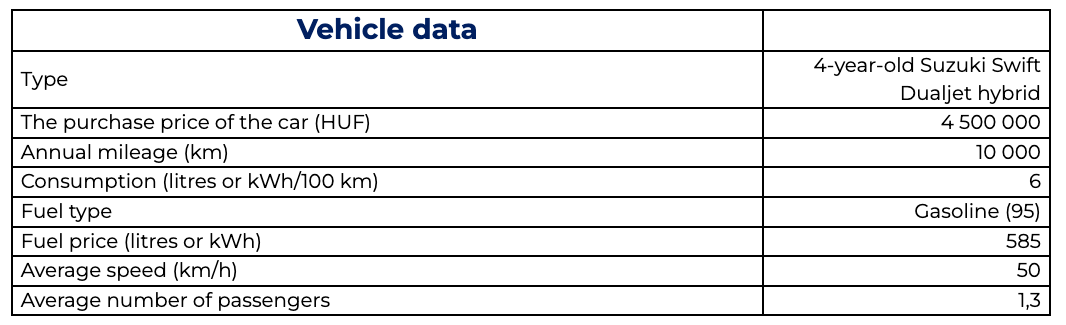
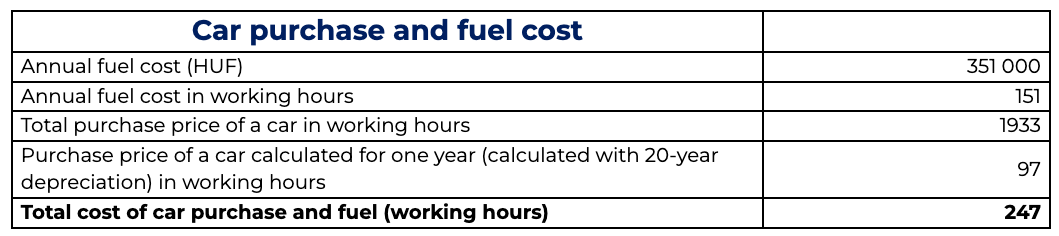
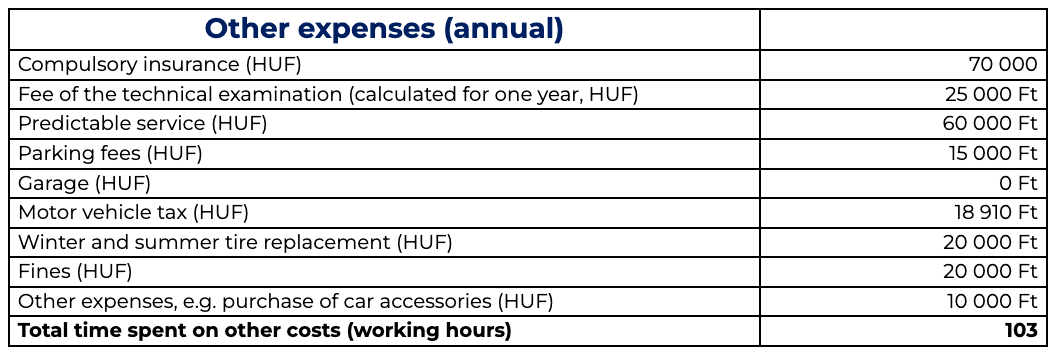
The model has an average fuel consumption of 6 litres per 100 kilometres and an annual mileage of 10,000 kilometres. The price of petrol 95 was around HUF 585 per litre in October 2025. From this, it is easy to calculate the amount spent on fuel each year: the mileage multiplied by the specific consumption and the fuel price, i.e. HUF 351,000. Other expenses (compulsory insurance, technical examination, vehicle tax, parking, tire change, etc.) amount to HUF 238,910 per year in our model. The cost of the car is HUF 4.5 million, and assuming that it is used for 20 years, the annual cost is HUF 225,000. We calculated 200 days a year and 6 minutes a day to search for a parking space, which is a total of 20 hours.
Although part of the time spent on driving falls into free time, we used the value of working time to calculate the costs. This is also recommended by the European Commission in its guide on cost-benefit analyses. This is all the more justified because for many people, free time is more valuable than working time.
The average annual speed, which can be calculated on the basis of the odometer, is very different from whether someone uses their car primarily within Budapest (where it is 22.6 km/h) or, say, between two rural settlements. We calculated with 50 km/h.
We took HUF 391,200 net per month as labour income, which is the net median wage in 2025 (the median means that half of Hungarians earn more than that, and half less than that). The annual statutory working time is 2016 hours (with an 8-hour working day in 2025).
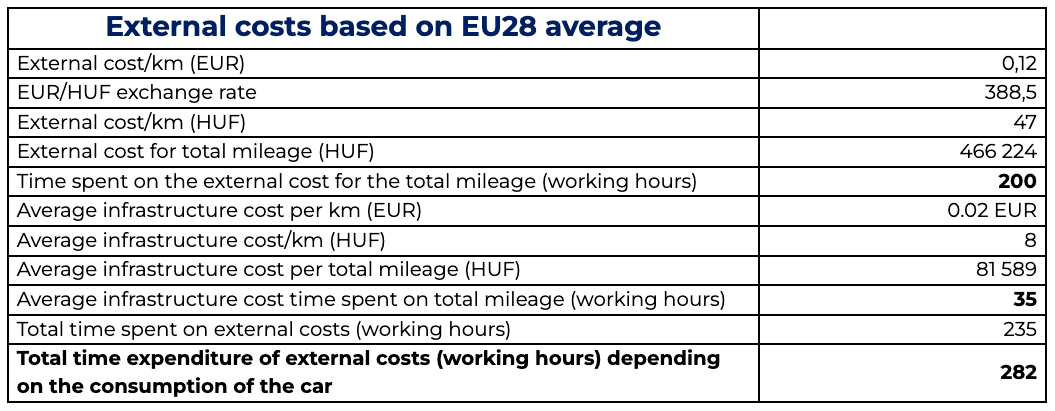
It is also necessary to take external costs into account. These are calculated by looking at: the amount that car users pay to the state treasury in the form of taxes and fees related to car use (fuel tax, car tax, road toll, etc.), and the cost to the state and society of creating and maintaining the necessary infrastructure for driving, as well as the environmental and health damage caused by driving (including climate change, air pollution, noise pollution and accidents). The difference between the two equals to the external costs, i.e. the costs that are passed on to society, not (directly) to the person who causes the costs (in this case, the user of the car). External costs would therefore have to be paid directly by car users (e.g. via road tolls) in accordance with “the user pays” and “the polluter pays” principles.
To get an idea of the size of the external costs, see the European Commission’s webpage on the Internalisation of transport external costs. In our model, we calculated an average of 0.12 euros per car per kilometre. Although we know that there can be significant differences between different types of cars, unfortunately such a breakdown is not available. Therefore, in the absence of any other option, and knowing that the resulting value is far from true in some cases, we applied a multiplier based on specific fuel consumption, calculated with 1 in our example car.
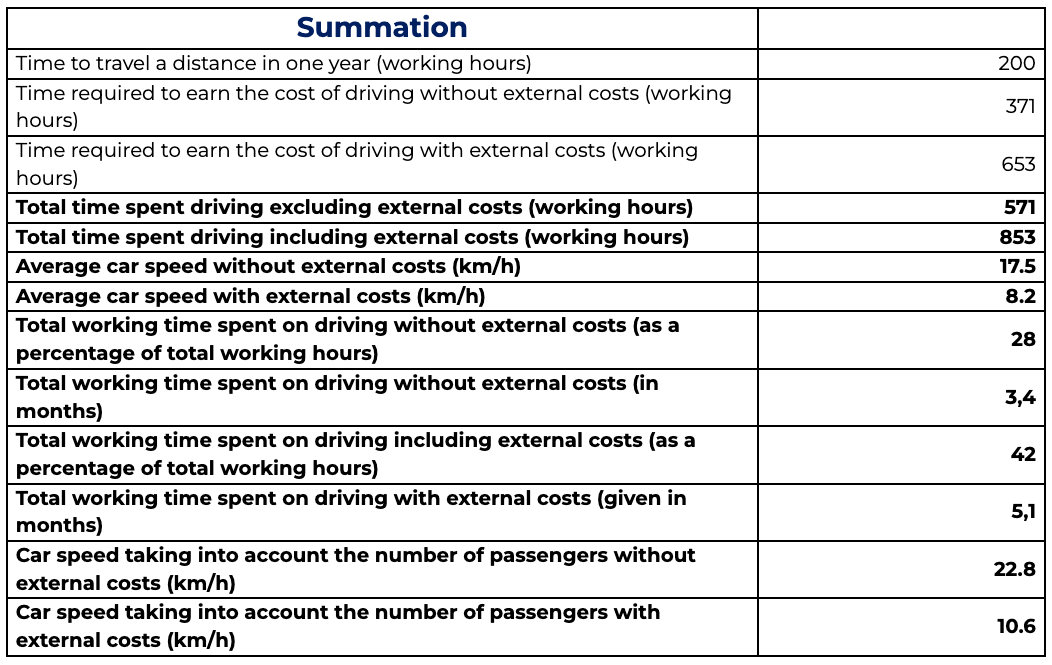
As a result, we found that the driver in our example spends about a quarter of his working time on car use, and his average speed – if he uses the car alone – is 17.5 km/h. And if we apply the polluter pays principle and also take into account external costs (which are also indirectly paid by the car owner to a greater or lesser extent), we come to the conclusion that the average driver spends more than 40 percent of his working time on his vehicle, and his average speed is 8.2 km/h.
In reality, however, it is not the speed of the car that is most important from the point of view of our calculation, but the speed of the person, so our table contains a multiplier for the average number of people sitting in the given car (in our example, this multiplier is 1.3). From this, we can conclude that our social speed increases significantly if more than one person travels in the same car at the same time.
The real speed of driving on the example of an “average car” in Hungary


It is reasonable to ask why we only calculate the costs and do not take into account the benefits of driving. It is quite obvious that driving has benefits, as car traffic has been continuously increasing for decades. However, it is impossible to create a universally valid Excel spreadsheet to calculate these benefits, as they depend on the individual and consist largely of subjective elements that are not usually monetised, although in principle they could be. To use a simple example: if someone travels to visit a historic castle 100 kilometres from his home, they are unlikely to conclude afterwards that they liked the castle so much that they would have paid twice as much money for petrol…
Therefore, if someone wants to calculate the benefits of using a car, they have to compile a table themselves and compare it with the expenses and speed. Anyone can quickly calculate the real speed of the car and the time spent driving with the help of the Excel spreadsheet that can be downloaded here.