
Research commissioned by Clean Cities found that car club parking tariffs far exceeded the price for parking a private car,
High charges from some London councils may have contributed to the exit of Zipcar from the UK at the start of the year, according to a network of over 140 environmental NGOs.
Independent research commissioned by Clean Cities found that car club parking tariffs far exceeded the price for parking a private car, with maximum costs averaging more than £900 per year per shared car. Worse still, many boroughs have policies leading to almost double this amount. [1]
Kensington and Chelsea, spiritual home of the SUV, had the highest maximum tariff for a car club parking permit, and could be charging up to £2,382 for a single car club permit, while the lowest was Merton at £80. A small number of boroughs do not charge for bay permits for car clubs, including Brent, Croydon, Harrow and Enfield.
Following the exit of Zipcar from the market Southwark Council promised to cut parking costs. Now, Richmond and Wandsworth Councils have pledged to cut the charges. Campaigners are calling for all London boroughs to follow suit ahead of local elections in May.
Seven local authorities: Barnet, Bexley, City of London, Havering, Hillingdon, Lewisham and Redbridge, indicated that car clubs do not operate in their local authority. The campaigners urge those local authorities to commit to implementing a borough car club action plan to get car sharing off the ground in their areas.
The research, compiled using FOI requests, is published as campaigners urge London councillors to commit to cutting car club charges ahead of crucial elections in May, with the goal that all residents can be within walking distance of an electric car they can hire.
Zak Bond, Campaign Manager at Clean Cities, said:
“The positive news is that some London boroughs are now starting to cut charges for car clubs, some of which were astronomical before. We know many people will feel like they are forced to buy a private car if they can no longer access a car club.
“Cutting costs is an important step towards rebuilding the market for electric car clubs in London, and indeed the rest of the UK. We’ll only tackle climate change and pollution if we give people access to affordable and convenient shared electric cars.”
Richard Dilks, Chief Executive of CoMoUK, said:
“We’ve warned for years that a difficult policy environment and rising costs would affect the viability of car clubs. Car clubs have faced sharp rises in costs such as council parking permits, insurance, charging costs for EVs and recent changes to the Congestion Charge. But there is hope – where boroughs commit to reducing costs, speeding up and simplifying processes and being flexible – we can restart the market and get back on the right path to healthier neighbourhoods for all.”
Zipcar was the largest car club operator in the UK, with an estimated 650,000 members across the country, and 550,000 in London including both residents and businesses.
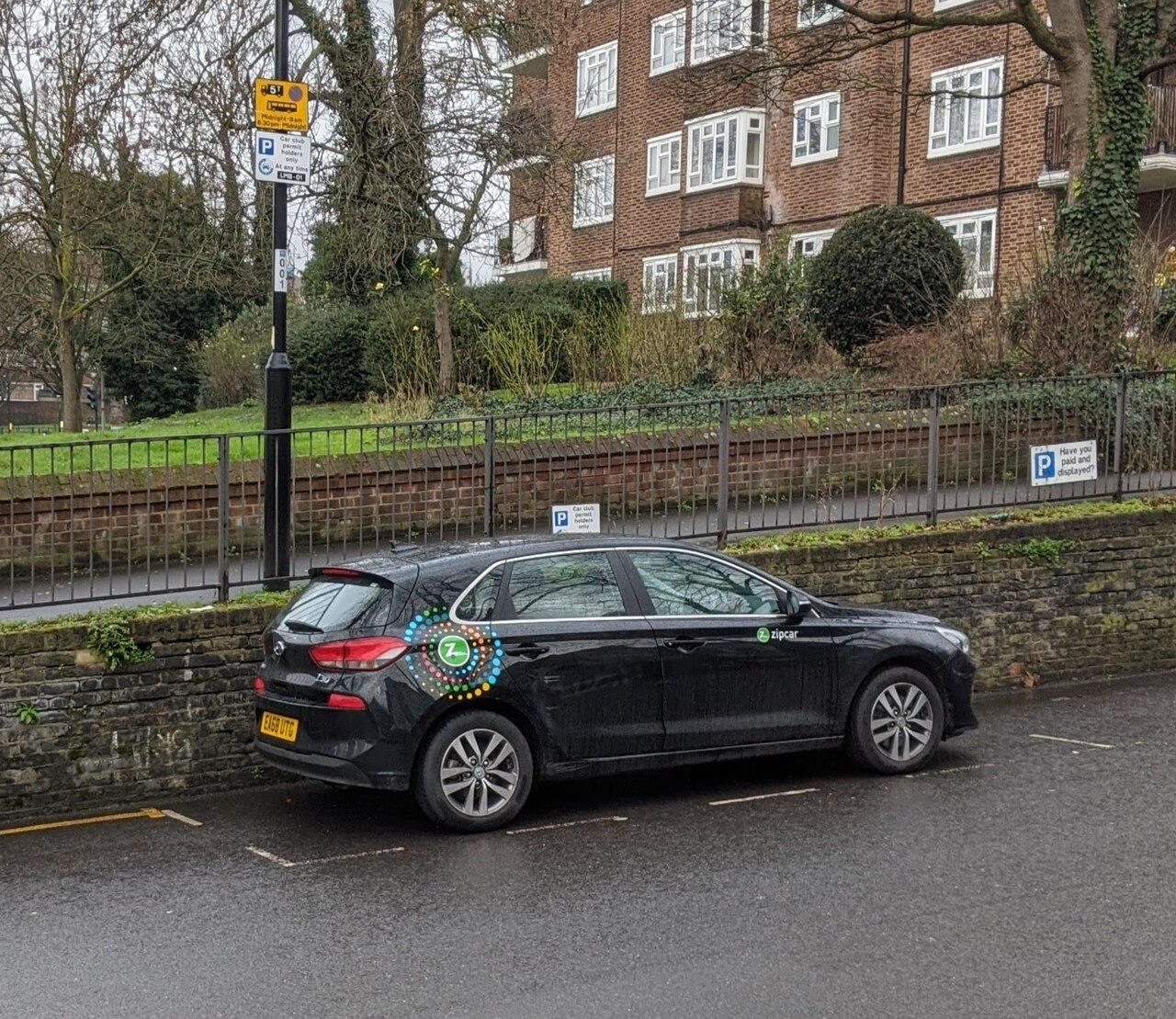
The expert analysis, produced by Thomas Fleming Transport Consulting Ltd. says that “while a car club vehicle may occupy a similar amount of kerbside space to a private car, its higher utilisation (up to 4.75 times higher) and its potential to replace up to 32 privately owned vehicles [in London] provide a strong policy rationale for preferential treatment through permit pricing”.
It follows previous research by Clean Cities, which found London was ranked 30th out of 42 cities in deploying electric car clubs in 2023 – behind major cities including Paris, Rome, Brussels and Berlin. [2]
Cllr Alexander Ehmann, Chair of Richmond Council’s Transport and Air Quality Committee, said:
“Car Clubs are a key part of reducing dependency on individual car ownership. We need to see growth in this area of shared mobility. Following Zip Car’s departure from London, Richmond Council has taken the bold decision to remove parking charges for any Car Club provider in our borough until at least 2027. We welcome new providers who can offer a great service to our residents.”
Cllr John Batteson, Cabinet Member for Climate Emergency, Jobs & Transport at Southwark Council, which was the first Borough to announce a policy change, said:
“We’re creating a cleaner, greener borough and car clubs have been vital in reducing private car ownership in Southwark, helping cut congestion and emissions while freeing up street space. Zipcar’s recent decision to cease operating in the UK was disappointing. Many Southwark residents relied on their service and it was an important part of our Streets for People programme.
“With 60% of households in Southwark not owning a car, we remain committed to supporting a strong and sustainable car‑sharing network for residents and businesses who need occasional vehicle access. That’s why we’re in talks with new car club operators, and we’ve offered free parking permits to car‑sharing providers until April 2027 – making us the first council to do so. We also want to work closely with the Mayor of London, Transport for London and other London councils so together we can support providers, build an environment across the capital where they can thrive and create better streets for everyone”
Cllr Jenny Yates, Cabinet Member for Transport at Wandsworth Council, said:
“We’re committed to keeping Wandsworth moving in a sustainable way. By waiving parking permit fees for car club operators, we’re taking action to keep and increase providers in the borough so that residents can benefit from accessible, affordable, and greener travel options.”
The research was compiled using Freedom of Information (FOI) requests issued to all London borough councils and the City of London Corporation. Whilst not able to ascertain the specific charges per vehicle owing to commercial sensitivity, this analysis shows that policies allow for high costs, especially compared to per vehicle costs for residents, giving a strong market signal to operators.
Tom Morris, a Dad of two, who lives in Lambeth, said:
“I was a regular Zipcar user as a way of trying to reduce my environmental impact as well as using bikes or public transport, but following Zipcar’s exit from the UK I have taken the decision to buy a private car.
It’s a huge challenge getting two kids around without access to flexible transport options. There’s a real opportunity for councils and City Hall to take practical steps to help by offering more support for car-sharing platforms and by extension support residents who are keen to find ways to lower their environmental impact.”
Clean Cities has recently published an Electrify London manifesto asking all councillors to commit to a car club action plan to ensure every resident should be within walking distance of an electric car club. The manifesto also urges measures to ensure an affordable EV charging network and support for local businesses to rapidly adopt electric vans and e-cargo bikes. [3]
The Electrify London coalition has united a diverse range of stakeholders from grassroots groups such as Mums for Lungs, to the Federation of Small Businesses and the London Taxi Drivers Association (LTDA).
On 7 May 2026, more than 1,800 London borough councillors will be elected with responsibility for 95 per cent of London’s roads and kerbside.
London’s net zero pathway requires nearly half of all car kilometres and a third of van kilometres to be electric within the next four years. Without strong local authority leadership and action in the next electoral term, these targets will not be achieved.
Notes to editors
[1] Independent research commissioned by Clean Cities:
Table – most expensive car club permits in London (FOI Returns)
BOROUGH / Car Club Tariffs | Minimum Tariff (£/yr) | Maximum Tariff (£/yr) |
Kensington & Chelsea | £893.00 | £2,382.00 |
Camden | £398.10 | £1,905.90 |
Islington | £308.10 | £1,700.20 |
Southwark | £1,500.00 | £1,700.00 |
Wandsworth | £1,152.00 | £1,597.00 |
Haringey | £700.00 | £1,540.00 |
Richmond upon Thames | £372.00 | £1,499.00 |
Waltham Forest | £210.00 | £1,386.00 |
Merton | £75.00 | £1,280.00 |
Tower Hamlets | £300.00 | £1,155.00 |
Hackney | £622.00 | £1,142.00 |
Lambeth | £650.00 | £793.57 |
Hammersmith & Fulham | £791.00 | £791.00 |
Barking and Dagenham | £470.00 | £715.00 |
Kingston upon Thames | £666.90 | £666.90 |
Bromley | £300.00 | £300.00 |
Greenwich | £280.00 | £280.00 |
Brent | £0 | £0 |
Croydon | £0 | £0 |
Enfield | £0 | £0 |
Harrow | £0 | £0 |
Average – All | £461.34 | £992.07 |
The following local authorities were omitted from the analysis at this stage due to incomplete data: Ealing, Hounslow, Newham, Sutton and Westminster.
Barnet, Bexley, City of London, Havering, Hillingdon, Lewisham and Redbridge indicated in response to the FOI that car clubs do not operate in their local authority.
NB. https://haringey.gov.uk/sites/
Haringey decided last year to almost quadruple the fee per bay for fixed services and almost double it for EVs for flexible car club schemes.
[2] Clean Cities City Ranking: THE STATE OF SHARED & ZERO-EMISSION MOBILITY IN EUROPEAN CITIES 2023 https://cleancitiescampaign.
[3] Electrify London manifesto: https://cleancitiescampaign.