
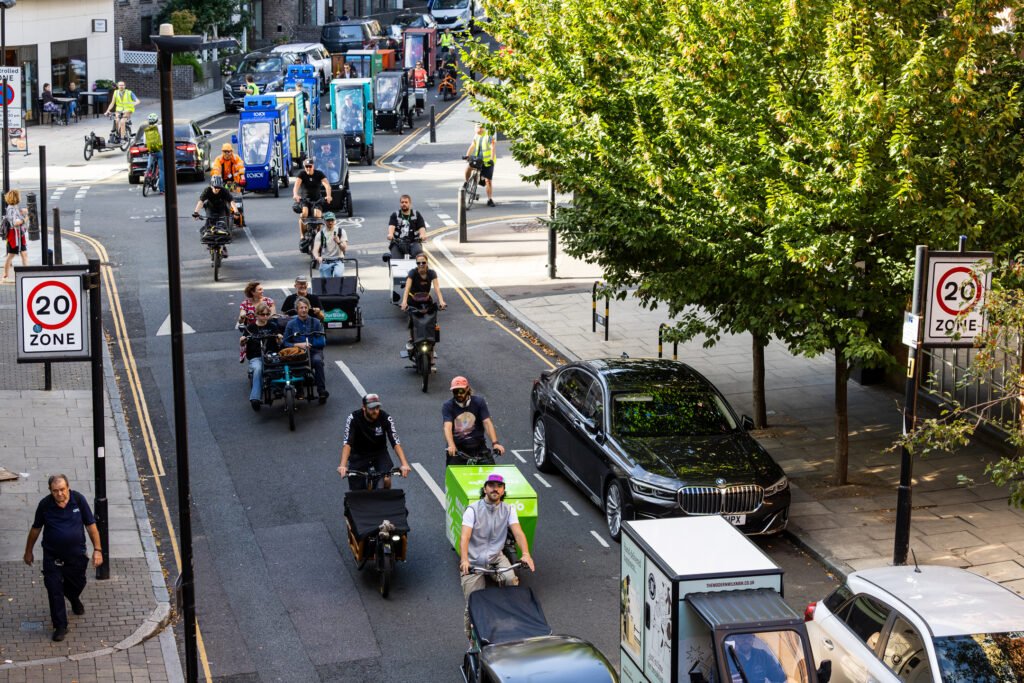
A coalition of businesses and organisations has come together to hold the seventh annual Cargo Bike Cruise, highlighting the growing role of cargo bikes in London and their potential to help decarbonise urban freight. The event showcased how cargo bikes can provide businesses with a cleaner, more efficient way to deliver goods and services across the capital.
The cruise was held on the same day diesel hit 200p a litre, a record high. Electric cargo bikes avoid these high fuel costs, so many businesses will be looking to them to cut costs and reduce their reliance on diesel.
More than 50 cargo bikes took to the streets in a convoy through central London, bringing together businesses at the forefront of the shift towards cleaner urban deliveries. The Cruise offers a visible demonstration of how cargo bikes are already helping to transform the way goods move around the capital.
The cruise included a diverse range of companies including:
Manufacturers including Minimal (a London based company), CityQ, and Vok were also represented.
Shifting more deliveries from vans to cargo bikes is a key way to support the transition to cleaner urban freight. Cargo bikes can offer businesses a practical alternative to diesel vans for many deliveries as well as servicing operations, helping to reduce congestion, pollution and carbon emissions while allowing operators to navigate increasingly busy urban streets.
The Cruise also demonstrated the possibility of using London’s river for freight, with some of the bikes crossing the Thames on Thames Clipper’s innovative new electric cargo boat.
Transport for London’s cycle count data shows that cargo bike use increased across London by 126% between 2022 and 2025. The highest growth was in inner London, where use increased by 149%. [1] The increase reflects the growing role that cargo bikes are playing in London’s streets, with businesses using them to transport everything from food and parcels to equipment and goods.
Recent analysis by Clean Cities has found that diesel vans are now the biggest road source of NOx emissions in central and inner London, underlining the importance of finding cleaner alternatives for urban deliveries. [2]
The Cruise was organised by Team London Bridge, Clean Cities and MP Smarter Travel.
Will Norman, the Mayor of London’s Walking and Cycling Commissioner, said:
“The capital’s roads are changing. To keep Londoners safe and build on our progress of on improving air quality, safety, and sustainable transport we must continue to adapt, innovate and work collaboratively across all sectors.
“Cargo bikes are an increasingly important part of London’s transport network, helping businesses to make deliveries efficiently while reducing congestion and emissions. It’s great to see the growth in their use and to see businesses coming together to celebrate their contribution towards creating a greener, safer and fairer London for everyone.”
Mark Riley, Delivery Design Manager (Process and Equipment) at Royal Mail, said:
“Royal Mail’s electric cargo cycles are helping us make deliveries across London more efficient while reducing emissions and improving air quality. They are an important part of our strategy to modernise our fleet and achieve Net-Zero by 2040.”
Zak Bond, Campaign Manager at Clean Cities, said:
“With diesel hitting £2 a litre, businesses will be thinking about how they can reduce their exposure to volatile fuel costs while helping to create cleaner, greener cities. Cargo bikes can do both. They offer a practical alternative to diesel vans for many deliveries and servicing jobs, and the 126% increase in their use shows that businesses are already getting on with the switch.
“We need the Mayor of London and Boroughs to back this transition by introducing zero emission zones for freight, starting in central London. That would give businesses the certainty they need to invest in cleaner vehicles like cargo bikes, while helping to cut pollution and get diesel vans off our streets.”
Jack Skillen, Director of Sustainability and Place at Team London Bridge (the Business Improvement District), said:
“London Bridge is home to a huge range of businesses that rely on deliveries and servicing every day, so finding cleaner and more efficient ways to move goods is really important. Cargo bikes can play a major role in making our streets cleaner, quieter and more efficient, while supporting local businesses. We’re delighted to be bringing businesses and cargo bike operators together again for this year’s Cargo Bike Cruise.”
Keith Doe, Director of Light Freight Logistics at Thames Clippers, said:
“Cargo by Thames Clippers is delighted to support the Cargo Bike Cruise and the important message it represents. We believe the River Thames has a significant role to play in transforming the way goods move around London, providing a cleaner, more efficient and reliable alternative to road-based deliveries. Our ambition is to become an integral part of London’s decarbonisation journey and to work alongside partners across the delivery sector to remove unnecessary road miles, reduce emissions and demonstrate what the future of urban freight can look like. The Cargo Bike Cruise is a fantastic example of how different modes of sustainable transport can work together, and we are proud to be part of that journey.”
[1] Transport for London, Delivering the Mayor’s Transport Strategy 2025/26, May 2026. The analysis is based on TfL’s 2022 and 2025 cycle counts. Data is collected in Central, Inner and Outer London at strategic locations on ‘neutral’ weekdays over 16 hours, mostly through video recordings that are manually reviewed, and counts are classified by cycle type. The data reflects individual counts of bicycles at specific locations which do not correspond to individual trips or bicycles.
[2] London Atmospheric Emissions Inventory (2022) https://data.london.gov.uk/dataset/london-atmospheric-emissions-inventory–laei–2022/